Turn scattered medical evidence
into an audit-ready EvidencePack.
V12 Medical Universe Navigator ingests mechanistic findings, cohort results, trial readouts and real-world observations, then converts them into a transparent, structured EvidencePack you can actually reason with.
(axes snapshot)
V12 processing pipeline
- Ingest mechanistic findings, cohorts, RCTs, real-world data
- Decompose causal pathways & semantic axes (T / Φ / Σ)
- Assemble a structured EvidencePack
See V12 on a real medical question
Run the full V12 EvidencePack pipeline on a mechanistic medical question. The demo instance shows the same structured diagnostics and axes snapshot as production.
What is V12 Medical Universe Navigator?
V12 is a clinical-grade evidence structuring engine. Instead of free-form generative text, it returns a transparent EvidencePack: an inspection-ready brief with explicit assumptions, axes and limitations that can be re-checked by humans.
Designed for clinical & translational teams
V12 is built for neurologists, trialists, epidemiologists and translational scientists who need to see how evidence lines up mechanistically, not just read another summary paragraph.
- Mechanistic & pathway-centric framing
- Explicit treatment of uncertainty and conflict
- Structured JSON & PDF for institutional workflows
Where it fits
V12 does not replace peer review or guideline committees. It sits upstream, helping research teams quickly assemble, inspect and stress-test the evidence around a biomarker, mechanism or hypothesis.
- Early-stage target and biomarker evaluation
- Evidence scans for trial concept development
- Portfolio and indication-expansion explorations
How the EvidencePack is assembled
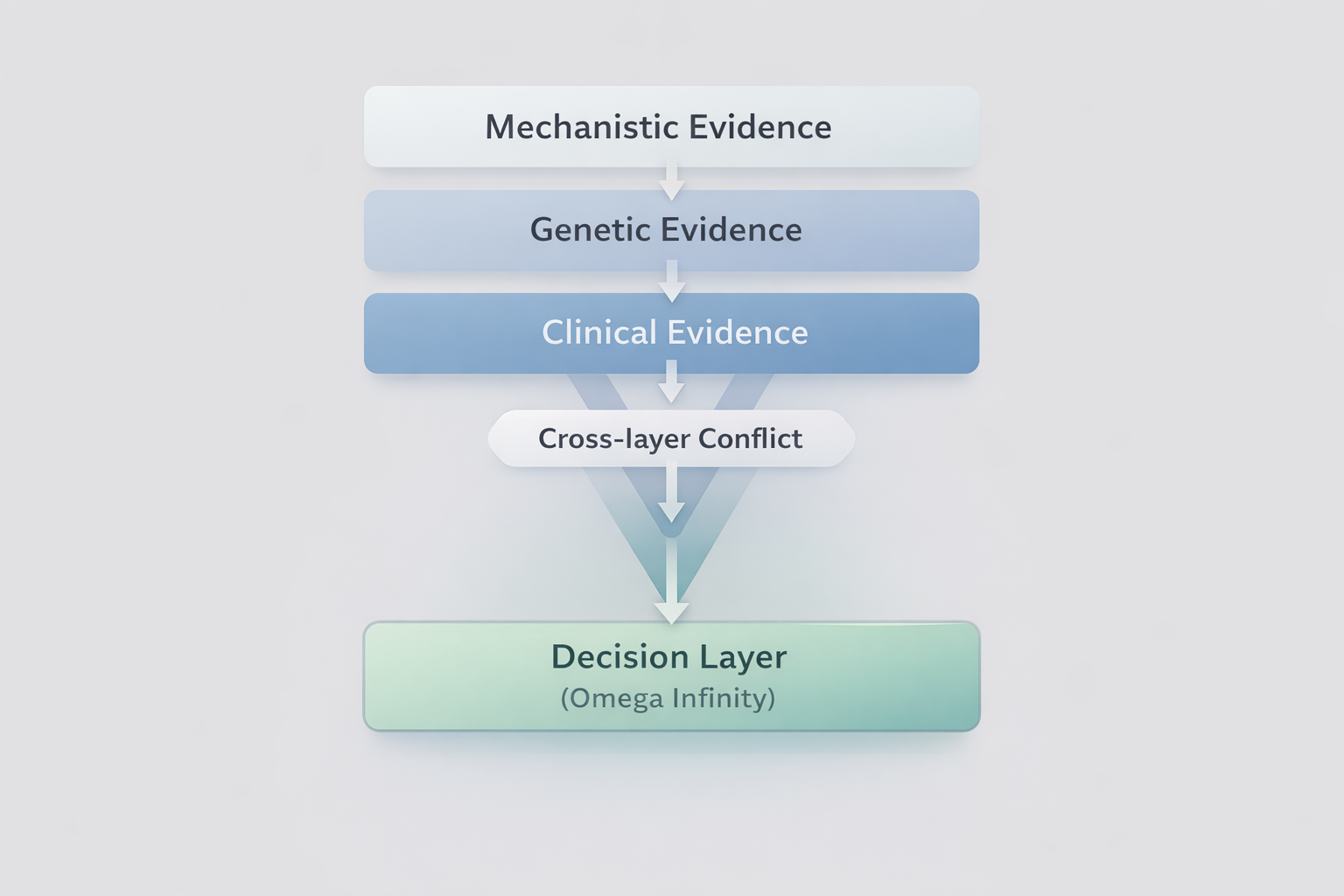
Under the hood, V12 runs a fixed probing template and SYC diagnostics over mechanistic, clinical and genetic streams, then compresses everything into a replayable EvidencePack.
1. Deep-Night first brief
A constrained “first pass” that organises the literature into mechanistic, clinical, genetic/causal and limitations lanes without trying to be exhaustive prose.
- Separation of signals vs. commentary
- Trackable references, not opaque quotes
2. SYC diagnostics & EvidencePack
The SYC layer measures tension (T), coherence (Φ) and structural completeness (Σ), plus phase / trajectory tags. These diagnostics, together with the structured brief, form the EvidencePack you see in the Navigator.
- Axes snapshot for each EvidencePack
- JSON schema suitable for pipelines & audit
See V12 on a real medical question
Use the live Navigator to run an EvidencePack on CRP & dementia, or bring your own mechanistic question. The demo shows the same structure and axes snapshot as the production engine.
Launch the Navigator Demo
This demo presents a static EvidencePack snapshot generated by the V12 engine, illustrating its evidence structure, assumptions, and diagnostic axes. It is intended for research exploration and methodological review, not for clinical decision-making.
Clinical Q&A: Why not just use a large language model?
Q: Large language models already summarize medical literature well. Why introduce V12?
A: Because summarization and evidence interpretation under uncertainty are not the same task. Large language models generate fluent explanations. V12 structures evidence — explicitly separating supported findings, assumptions, and uncertainty.
Q: Does V12 replace GPT or other LLMs?
A: No. V12 does not compete with language models. It constrains evidence representation for humain review. LLMs provide language; V12 enforces an inspection-ready evidence structure suitable for clinical and translational review.
V12 supports research interpretation and evidence stress-testing — not clinical decision-making.